
Sole Purpose 113
If You Aren’t at the Table, You’re on the Menu -
A Conversation With James Whelan, DPM
If You Aren’t at the Table, You’re on the Menu -
A Conversation With James Whelan, DPM
Introduction
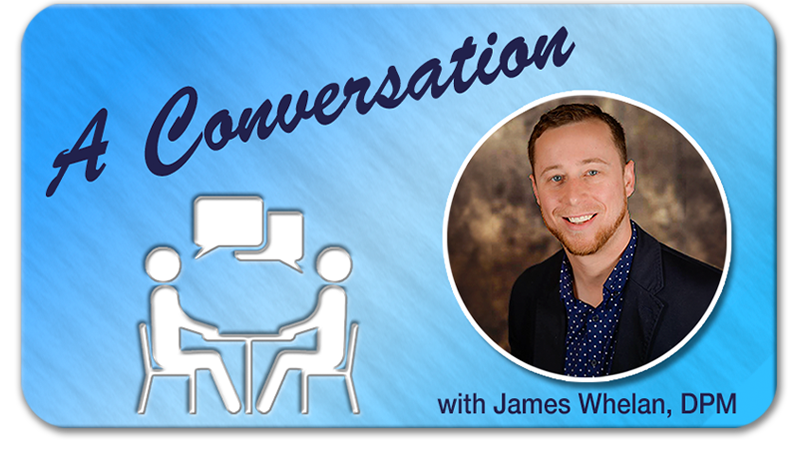
I’ll be honest — I had been following Dr James Whelan on social media for a while before I actually got to meet him in person (@wifootdoc, if you aren’t already following). There’s something about watching someone operate, advocate, and parent a toddler in real time on Instagram that makes you feel like you know them before you ever shake hands. But it wasn’t until this past House of Delegates for the American Podiatric Medical Association (APMA) that I finally got to sit down with him face to face — and I’m really glad I did. Truly an amazing individual and our profession is lucky to have him!
Dr Whelan is an attending physician in Wisconsin and plays an active role in resident training at OSF St Katherine in Dixon, Illinois, which is about an hour’s drive from where he practices. He completed his residency at Wheaton Franciscan Healthcare, followed by a fellowship in foot and ankle reconstruction, deformity correction, and limb salvage in Omaha, Nebraska. He is currently Chair of the Wisconsin Licensing Board, has participated in the APMA House of Delegates for the last three years going on four, and serves on the Health Policy Committee for ACFAS. He was also part of ACFAS’s Emerging Leaders Program (ELP), a leadership development track for up-and-coming voices in the profession.
On paper, that’s a lot of acronyms and titles. In person, he’s just a straightforward, thoughtful guy who genuinely cares about moving the profession forward — and, as you’ll read, he isn’t afraid to name what’s broken.
How It All Started
Q: You’ve described your path to podiatry as ‘not a crazy fancy story.’ So, what actually happened?
Dr Whelan: It was a pretty simple experience, honestly. During undergrad, I reached out to a local hospital and arranged to shadow in the OR. I basically bounced from room to room, watching different surgical specialties — OB/GYN, vascular surgery, and podiatry. When I watched the podiatrist working on an ankle procedure, what stood out wasn’t necessarily the surgery itself. It was the way the surgeon carried themselves. How they communicated with the patient, how they interacted with every member of the OR team. That kind of leadership presence clicked for me immediately. And I think it also mattered that I got to see the scope of podiatry early on — that set the tone for how I thought about the profession from the beginning.
It’s a good reminder that we don’t always need a dramatic origin story. Sometimes a single afternoon of shadowing is all it takes — if you’re paying attention.
Savannah’s Thoughts:
One of the most impactful tools we have for student recruitment in podiatry is also one of the simplest: exposure. Time and again, it’s shadowing that sparks a student’s initial interest and ultimately leads them to apply. It’s also worth remembering that a letter of recommendation from a podiatrist is a required component of the application process. Opening your clinic—or even your operating room—to students isn’t just an act of mentorship; it’s an investment in the future of our profession. For many, that first experience in your space has the potential to be truly life changing. I know I will forever be grateful to Dr Kipp Henning in Colorado Springs and the impact she had for me in undergrad.
From Indifferent Student to Political Advocate
If you’d told Dr Whelan as a podiatric medical student that he’d one day be chairing a state licensing board and advocating on Capitol Hill, he would not have believed you.
Q: You’re very involved in podiatric politics — APMA House of Delegates, ACFAS committees, the Wisconsin Licensing Board. For residents who hear ‘politics’ and immediately tune out, what would you say to them?
Dr Whelan: I was exactly that person. As a student, I had zero interest in anything politics related. But a mentor of mine — Dr Bob Sage — put it simply: ‘Just start hanging out with the right people and this is what happens.’ That’s genuinely how it starts. You get around people who are engaged, and you start noticing the gaps. Scope misunderstandings, reimbursement problems, patient safety issues — these aren’t abstract policy debates. They show up in your clinic. And if we don’t step up and step in, the decisions end up getting made without us. It comes down to a simple truth: if you don’t have a seat at the table, you’re on the menu.
It’s worth noting that Dr Whelan isn’t just talking about attending a conference once a year and calling it advocacy. He’s been to three consecutive APMA Houses of Delegates (heading into his fourth), participates in the ACFAS Health Policy Committee, and chairs the Wisconsin Licensing Board — all while running a full clinical practice and training residents. His involvement isn’t performative. It’s a sustained commitment built over years.

The Biggest Threat Facing Podiatry Right Now
This was the part of our conversation that I wasn’t expecting to go as deep as it did. When I asked Dr Whelan what he sees as the greatest threat to the profession, he didn’t go to the usual answers.
Q: What do you feel is the biggest threat facing podiatry today?
Dr Whelan: We hear a lot of hot topics — student recruitment, board certification debates. But what I’m genuinely concerned about is the increasing medicalization of foot care by providers who are not medically trained to manage complex pathology. Specifically, I’m seeing RNs and LPNs operating in independent, cash-pay settings treating patients with high-risk conditions — peripheral arterial disease, diabetes, active infections. There’s no clear regulatory structure, and that is fundamentally a patient safety problem.
He didn’t stop at identifying the issue. He’s already working on a solution.
Dr Whelan: I’ve asked the APMA to implement a task force to address this from a regulatory and educational standpoint. I think dentistry offers us a useful model here. Dentists don’t face the same problem to the same extent because they’ve integrated dental hygienists into their care model under clear supervision frameworks. What I’d love to see is a pathway where medical assistants undergo a specialized training process so they can perform routine foot care under appropriate DPM supervision — potentially Medicare-sponsored. It addresses both patient safety and patient access. We’re not trying to eliminate access to foot care. We’re trying to make it safer.
He pointed to the work of Dr Janice Simon in New Mexico as a model for thinking about underserved patient populations — noting that any solution must hold both patient safety and patient access in mind simultaneously, not treat them as competing values.
Building Better Residents: Coaching, Culture, and Constructive Feedback
Ask any residency director what makes a great training program, and you’ll usually hear some combination of case volume, surgical complexity, and attending experience. Dr Whelan doesn’t disagree with any of that — but he’d add something that often gets left off the list: psychological safety.
Q: You’re a strong advocate for resident wellness and what you describe as ‘psychological safety.’ What does that actually look like in practice?
Dr Whelan: It starts from the top down — with the residency director. Resident wellness matters because burnout has become almost normalized in our training culture. Residents are already juggling surgery, academics, research, and some semblance of a personal life. If the culture of the program doesn’t support them, all of that sustainable growth just doesn’t happen. You need clear expectations, good educators, and an environment where residents feel safe asking questions and making mistakes.
One of the things he’s actively working to build into his program is structured coaching — not just informal feedback at the end of a case, but intentional, systematic debrief.
Dr Whelan: Athletes have coaches. Why shouldn’t surgeons? In general surgery, some programs actually record operations and review the footage afterward. We’re not quite there yet in podiatry, but the concept is the same — intraoperative feedback is important, and so is a debrief at the end of the day. It creates a culture of reflection rather than just reaction.
He also noted a structural challenge unique to podiatry: because so many of our residents train at community hospitals rather than large academic medical centers, the administrative infrastructure that supports residents — robust GME offices, formalized wellness programs, regular faculty development — is often thinner. That leadership element, as he put it, can get lost.
Starting this year, his program is piloting a new initiative where first-year residents will spend a full dedicated month with him, specifically designed to build confidence in surgical decision-making earlier in training.
Q: What do you tell yourself in those high-stress moments when a surgery isn’t going perfectly?
Dr Whelan: Respond, don’t react. That’s the internal mantra. It’s about settling yourself before you say something. I was working with a third year recently on a subtalar joint dissection — he was trying to preserve the calcaneofibular ligament and just went right through it. In that moment, I had to take a breath. I gave him the immediate feedback, made clear it wouldn’t have a detrimental effect on this patient, and explained what we’d approach differently next time. That’s the goal: don’t let frustration drive the teaching moment.
For those of us in residency who have been on the receiving end of both kinds of feedback — the kind that builds you up and the kind that makes you want to disappear into the floor — this is a meaningful distinction. The best attendings I’ve worked with have all had this quality: they can hold the standard high and still make you feel like you can meet it.




On Fellowships: Nuanced Takes for the Right Applicant
Fellowship came up naturally in our conversation, and his take was one I appreciated for its honesty.
Q: How do you think about fellowship — is it the right move for everyone?
Dr Whelan: I’m pretty indifferent, honestly — and I say that as someone who did one. I think fellowship is a strong choice for the right applicant. Some people genuinely need a little more refinement. Some want extra exposure in a specific area — total ankle replacement, minimally invasive surgery, Charcot reconstruction. For others, it’s a confidence thing, or they want a different learning environment or teaching style. Some programs do a noticeably better job than others. But if you’re already a well-trained, confident surgeon coming out of a strong residency? Fellowship isn’t automatically the answer.
That kind of honest, non-prescriptive take is rare, and I think residents need to hear it more often. The pressure to pursue fellowship — often more social than clinical in origin — doesn’t serve everyone equally.
Social Media, Scope, and Showing Up Visibly
If you follow Dr Whelan online, you know his social media presence isn’t just before-and-after case photos. He posts about HOD proceedings, legislative issues, and the real texture of practice life. I asked him how he thinks about it.
Q: You’re very active on social media. How does that fit into your professional identity?
Dr Whelan: For me, it’s an extension of education and networking. There’s real value in seeing your peers showcase their scope and their outcomes in a visible, accessible way. At first, the exposure can feel scary — you’re putting your work out there publicly. But it’s been overwhelmingly positive. I’ve learned a tremendous amount from watching others, and I’ve gotten to connect with like-minded people I never would have met otherwise.
He’s intentional about what he posts: keeping it educational, aligned with how he actually practices, and not pigeonholing himself into one niche. He posts about workflow improvements, decision-making on complex cases, complications, and — increasingly — the advocacy work he’s been doing. He used the most recent HOD as a live-posting opportunity, documenting the issues being discussed in real time.
Dr Whelan: Not everyone is going to follow the House of Delegates closely, but if they see their colleague posting about it, they might start to care. That matters.

The Cases He Loves Most
I always like asking surgeons what cases genuinely excite them — not the ones they’re supposed to love, but the ones that actually get them out of bed. For Dr Whelan, the answer was immediate.
Dr Whelan: Revision cases. Any revision-type case is my favorite. They require a completely different kind of thinking — especially when they’re not your own prior work. You have to reverse-engineer what happened, respect the biology of what’s already been done, and build a thoughtful approach forward. They’re some of the most rewarding cases I do.
There’s something telling about that answer. Revision surgery is where the ego has to step aside entirely — it’s not about showing off a technique, it’s about solving a problem with what you’ve got. That mindset tracks with everything else he described.
The 5 AM Club, the Toddler Bedtime, and Keeping It All Together
I had to ask. Because from the outside, the math of his life doesn’t obviously add up: full-time practice, resident training, licensing board chair, APMA delegate, ACFAS committee work, active social media, and a toddler at home.
Q: How do you actually make time for all of it?
Dr Whelan: I try to go to bed when the toddler goes to bed — which is around 7:30. That sounds extreme, but it’s the only way I can make the 5 AM Club work. The early morning is everything. It’s the quiet before the day goes completely sideways, and it’s when I can actually get through the to-do list. I wasn’t a morning person before — this is a change from the last year or so. By the end of the day, I’m just too exhausted to get anything meaningful done.
Beyond the schedule hacks, he talked a lot about the harder skill: learning when to say no. Early in practice, he said yes to almost everything. Now he’s quicker to decline if something doesn’t align with where he’s trying to go. And before committing to anything significant, he runs it by his wife — who, as he described it, has veto power. Full stop.
Dr Whelan: She’s the reason I’m able to do any of this. If we’re not aligned, nothing else works. You have to put in the time with family — not just in theory, but actually. You can work incredibly hard for the profession and still have everything fall apart if you’re not intentional about that.
What He’d Tell His Younger Self
I asked him the question I ask every person I interview, because the answers always reveal something true.
Q: What’s the one thing you’d tell your younger self as a resident or student?
Dr Whelan: You belong. That’s it. It’s incredibly easy to question whether you’ve earned your place — that imposter syndrome is real, and it follows a lot of us well past residency. But you don’t need to have everything figured out early. Your career doesn’t need to start with a perfectly formed plan. What matters more than anything is the relationships you build. I’m still drawing on connections I made during residency, three years out. Collaboration, mentorship, showing up for people — that compounds.
He also spoke about alignment — making sure that the people you build your professional and personal life with are actually pointed in the same direction you are. It’s not flashy advice, but it’s the kind that comes from having lived it.
Final Thoughts
What I kept coming back to after our conversation was this: Dr Whelan is not someone who fell into leadership by accident. He made deliberate choices, showed up consistently, and built something over time. The licensing board seat didn’t appear overnight. The advocacy work didn’t start from a place of certainty. It started from noticing gaps and deciding not to look away.
For residents reading this: you don’t have to have a perfectly mapped-out career plan. You don’t have to do fellowship unless it genuinely serves you. You don’t have to be naturally political to eventually care deeply about the policy decisions that shape your patients’ lives. But you do have to start hanging out with the right people. And you have to believe, even on the days when it’s hardest, that you belong at the table.
Because if you’re not there, someone else is making the menu.


This blog and the overall sponsorship of PRESENT Podiatry was made possible through the support of our sponsors:








Comments
There are 0 comments for this article